PIQP has a specialized backend to solve multistage optimization problems of the following form considerably more efficient:
\[\begin{aligned} \min_{x, g} \quad & \sum_{i=0}^{N-1} \ell_i(x_i,x_{i+1},g) + \ell_N(x_N,g) \\ \text {s.t.}\quad & A_ix_i+B_ix_{i+1}+E_ig = b_i,\hspace{0.5em} i=0,\dots,N-1, \\ & C_ix_i+D_ix_{i+1}+F_ig \leq h_i,\hspace{0.40em} i=0,\dots,N-1, \\ & A_Nx_N + E_Ng = b_N, \\ & D_Nx_N + F_Ng \leq h_N, \end{aligned}\]with \(N\) stages and coupled stage cost
\[\ell_i \coloneqq \frac{1}{2}\begin{bmatrix} x_i \\ x_{i+1} \\ g \end{bmatrix}^\top\begin{bmatrix} Q_i & S_i^\top & T_i^\top \\ S_i & 0 & 0 \\ T_i & 0 & 0 \end{bmatrix}\begin{bmatrix} x_i \\ x_{i+1} \\ g \end{bmatrix}+ c_i^\top x_i,\]and terminal cost
\[\ell_N \coloneqq \frac{1}{2}\begin{bmatrix} x_N \\ g \end{bmatrix}^\top\begin{bmatrix} Q_N & T_N^\top \\ T_N & Q_g \end{bmatrix}\begin{bmatrix} x_N \\ g \end{bmatrix}+ c_N^\top x_N + c_g^\top g,\]where \(x_i\in\mathbb{R}^{n_i}\) are the stage variables, \(g\in\mathbb{R}^{n_g}\) is a global variable, and \(N \in \mathbb{N}\) is the horizon. The matrices \(Q_i\in\mathbb{S}_+^{n_i}\), \(S_i\in\mathbb{R}_+^{n_{i+1}\times n_i}\), and \(T_i\in\mathbb{R}_+^{n_g\times n_i}\) together with \(c_i\in\mathbb{R}^{n_i}\) and \(c_g\in\mathbb{R}^{n_g}\) form the coupled cost. Stages are also coupled through equality and inequality constraints with \(A_i \in \mathbb{R}^{p_i\times n_i}\), \(B_i \in \mathbb{R}^{p_i\times n_{i+1}}\), \(E_i \in \mathbb{R}^{p_i\times n_g}\), \(b_i \in \mathbb{R}^{p}\), \(C_i \in \mathbb{R}^{m_i\times n_i}\), \(D_i \in \mathbb{R}^{m_i\times n_{i+1}}\), and \(h_i \in \mathbb{R}^{m_i\times n_g}\), respectively.
An extensive example showcasing the multistage capabilities is the Robust Scenario MPC Example.
Interface
The interface is the same as for the general sparse QP problem
\[\begin{aligned} \min_{x} \quad & \frac{1}{2} x^\top P x + c^\top x \\ \text {s.t.}\quad & Ax=b, \\ & h_l \leq Gx \leq h_u, \\ & x_l \leq x \leq x_u, \end{aligned}\]PIQP detects the structure automatically and extracts the dense blocks from the sparse problem data.
The order of the decision variables is important and has to match the multistage optimization problem, i.e. \(x = (x_0, x_1, \dots, x_N, g)\). The order of the constraints \(Ax=b\) and \(h_l \leq Gx \leq h_u\) can be arbitrary, i.e., gets correctly permuted internally.
Changing the KKT solver backend amounts to adding one line, by changing the kkt_solver setting. Make sure you use the sparse solver interface and set the setting before the setup function.
C++
solver.settings().kkt_solver = piqp::KKTSolver::sparse_multistage;
C
settings->kkt_solver = PIQP_SPARSE_MULTISTAGE;
Python
solver.settings.kkt_solver = piqp.KKTSolver.sparse_multistage
Matlab
solver.update_settings('kkt_solver', 'sparse_multistage');
Multithreading
The sparse_multistage_parallel backend factorizes the KKT system in parallel by splitting the horizon into segments, which can significantly speed up problems with long horizons. It requires PIQP to be built with OpenMP and Blasfeo (-DBUILD_WITH_OPENMP=ON -DBUILD_WITH_BLASFEO=ON).
The prebuilt packages (e.g. pip install piqp) are built without OpenMP, i.e., PIQP has to be built from source.
solver.settings().kkt_solver = piqp::KKTSolver::sparse_multistage_parallel;
solver.settings().num_threads = 6;
The default num_threads = 0 uses the OpenMP default, usually all logical cores, which is rarely the fastest choice. We recommend setting num_threads to the number of performance cores.
OpenMP runtime settings
- On CPUs with performance and efficiency cores (e.g. Apple Silicon, Intel 12th gen or newer), LLVM OpenMP (Clang, macOS) puts idle threads to sleep immediately, which slows down short horizons considerably. Setting
KMP_BLOCKTIME=200ms(orOMP_WAIT_POLICY=active) keeps the threads active and can make the solver several times faster. - On Linux, binding threads to cores (
OMP_PLACES=cores OMP_PROC_BIND=close), ideally restricted to performance cores, further improves performance. Thread binding is not supported on macOS.
Partition strategy
The horizon is split into segments, one per thread, which are separated by single stage blocks. By permuting these separators together with the global variable to the end of the KKT matrix, the segments become decoupled and can be factorized in parallel. Only the remaining reduced system of the separators and the global variable has to be factorized sequentially. Forward and backward substitutions follow the same parallel/sequential pattern. Since the segments get coupled to their preceding separator, some fill-in is introduced. To compensate for that, the first segment, which has no fill-in, is chosen longer than the others.
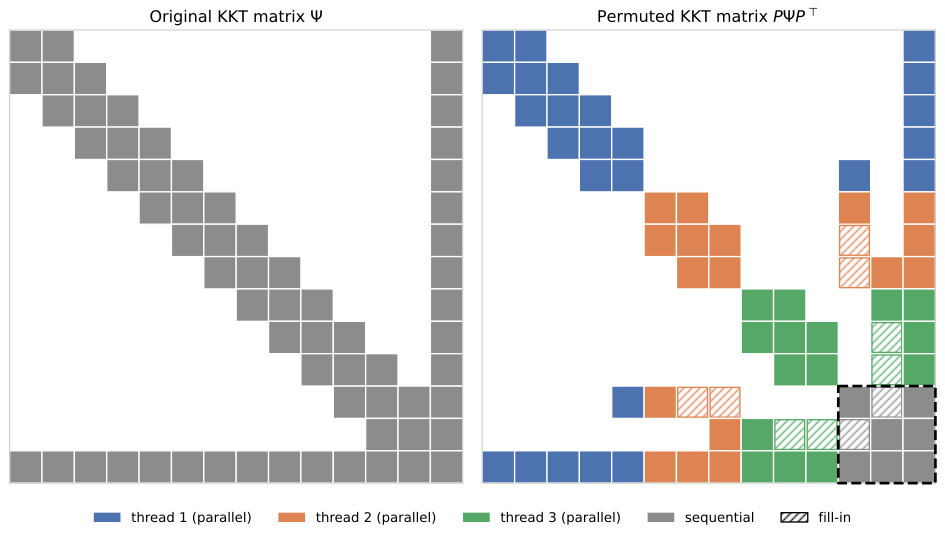
Due to the fill-in and the sequential reduced system, the speedup is limited. The theoretical maximum speedup of the factorization for long horizons is
| Threads \(p\) | Max speedup |
|---|---|
| 2 | 1.37 |
| 4 | 2.11 |
| 6 | 2.84 |
| 8 | 3.58 |
| 10 | 4.32 |
| 12 | 5.05 |
| 14 | 5.79 |
| 16 | 6.53 |
The partition strategy assumes that the factorization dominates the computation time and estimates the cost of each stage block by the cube of its size. The speedups additionally assume that all stage blocks have the same size. More details can be found in the paper.
If consecutive stages are decoupled, e.g., between scenarios in scenario MPC, segments can also be split there without a separator and fill-in. The segments and separators are chosen automatically by minimizing the estimated factorization time, i.e., the maximum segment cost plus the sequential cost of the separators. Hence, scenarios are grouped evenly over the threads, and if there are fewer scenarios than threads, scenarios are further split using separators.